Q14)
Q15)
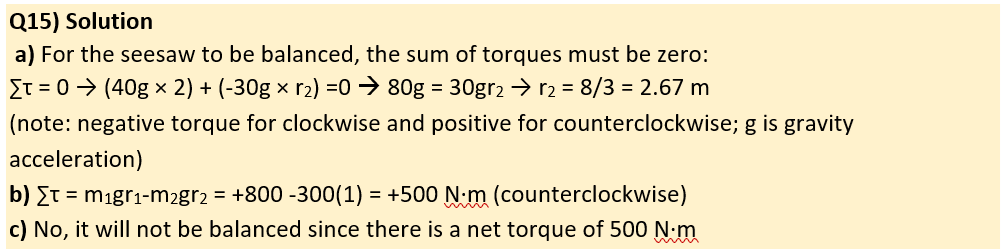
Q15) A seesaw is a classic example of a lever system. Consider a seesaw with a fulcrum placed at its center. A 40 kg (m1) child sits 2 meters from the fulcrum on the left side, and a 30 kg child (m2) sits on the other side (right side) of the seesaw.
a) Determine the distance from the fulcrum where the 30 kg child should sit to balance the seesaw.
b) If the 30 kg child moves to a new position 1 meter from the fulcrum, calculate the torque produced by both children.
c) Explain whether the seesaw will be balanced or not when the 30 kg child is at the new position.
Q16)
Q17)

Q18)
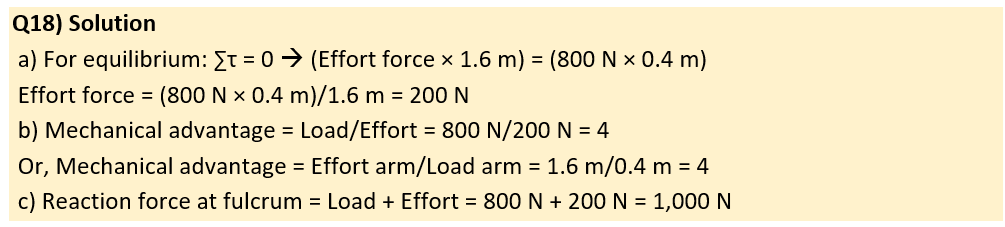
Q18) A class 2 lever has a load of 800 N placed 0.4 m from the fulcrum. If the effort is applied at 1.6 m from the fulcrum, calculate:
a) the effort force needed to balance the load?
b) the mechanical advantage of the lever?
c) the reaction force at the fulcrum when the system is in equilibrium?
Q19)
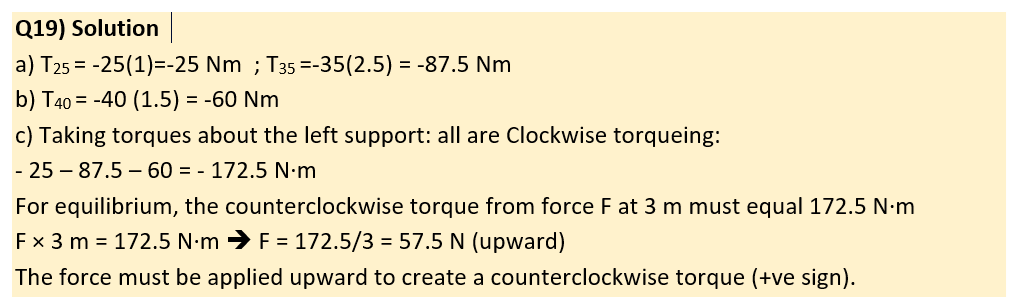
Q19) A uniform horizontal rod with length 3 m and weight 40 N is supported at its left end. A 25 N weight is suspended from the rod at a distance of 1 m from the left end, and a 35 N weight is suspended at a distance of 2.5 m from the left end.
a) Calculate the torque of each weight? (25 N and 35 N)
b) Calculate the torque of the rod itself (Hint: Consider the CG at the middle) c) Calculate the magnitude and direction of the force that must be applied at the right end to maintain the rod in horizontal equilibrium.